
During the harvesting of cinnamon trees (particularly for cinnamon leaf oil production), the leafy branches and untrimmed shoots are cut and left in the field. These leaves are field-dried for approximately 3 to 5 days, after which the material is tied into bundles specifically prepared for cinnamon leaf oil distillation.
Once bundled, the leaves must be transported to the cinnamon leaf oil extraction facility (cinnamon distillation boiler). It is not advisable to leave the leaf material in the field for more than five days, as extended exposure reduces the yield of cinnamon leaf oil. Furthermore, after drying, the leaves must be protected from rain. If the dried leaves are re-wetted, the cinnamon leaf oil yield decreases even further.
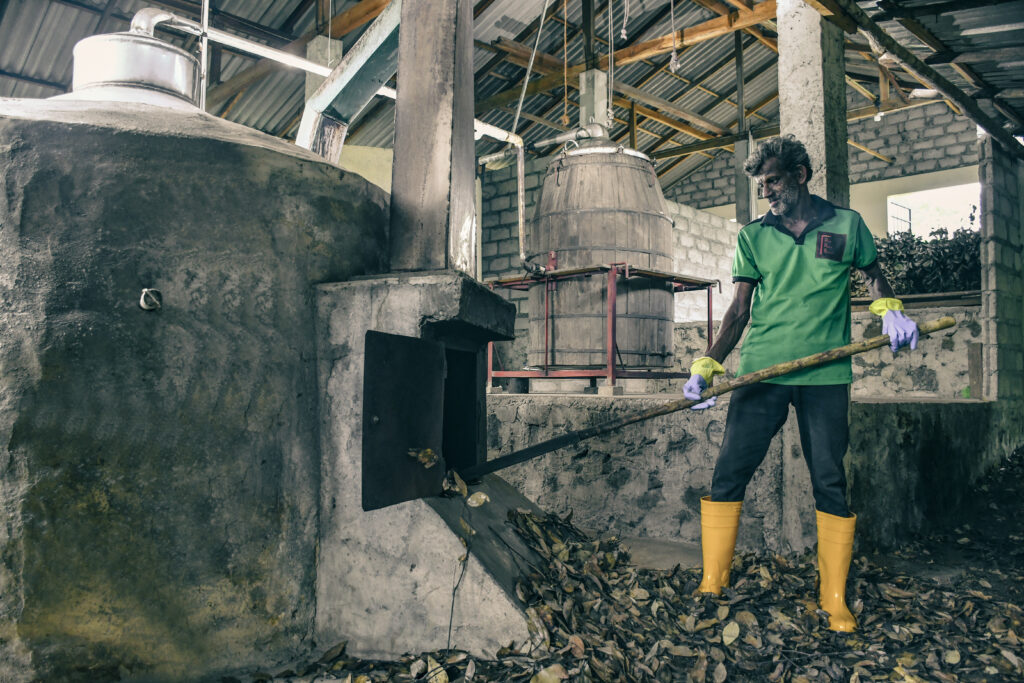
A typical cinnamon leaf oil distillation unit consists of an external boiler, a distillation chamber, and a condenser. Generally, the distillation chamber used for cinnamon leaf oil extraction is constructed from stainless steel. The condenser coils, also manufactured from stainless steel, are submerged in a water-cooling tank.
During the process, the vapor mixture containing cinnamon leaf oil passes through the condenser and undergoes condensation, converting the vapor into liquid form. For the separation of the cinnamon leaf oil from the hydrosol, three vessels—used sequentially—are employed. These vessels, known as “karadé,” help separate the essential oil phase.
The final cinnamon leaf oil collected should be a clear liquid, either light yellow to deep yellow in colour, free from floating particles or sediment, meeting the expected quality parameters for high-grade Ceylon cinnamon leaf oil.